
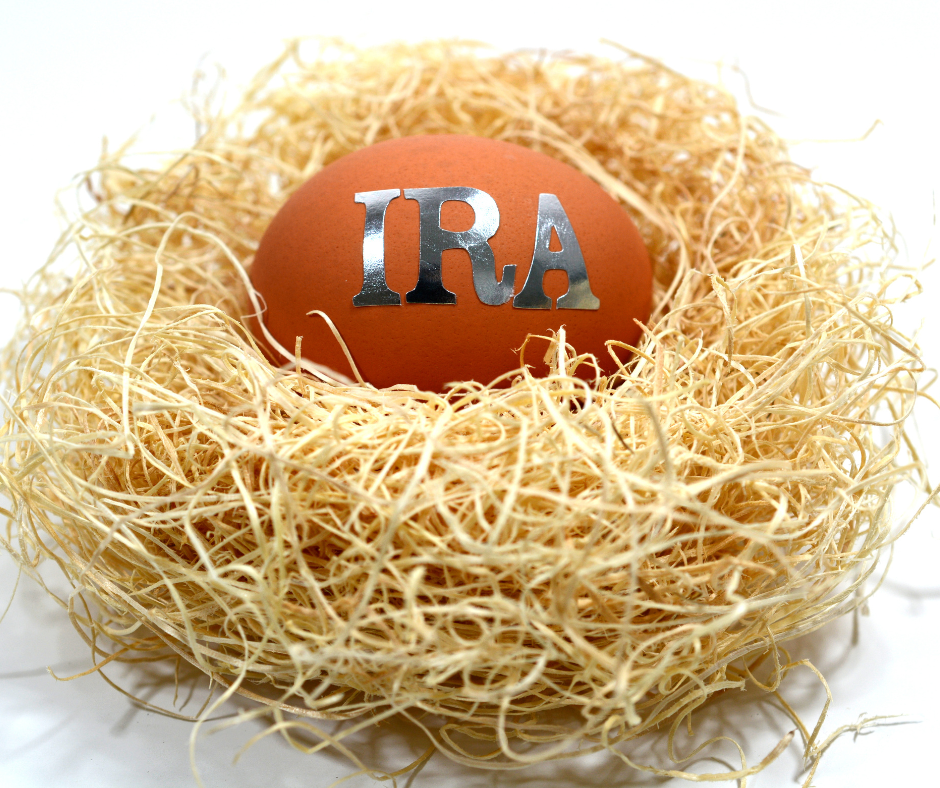
Congress enacted a new type of retirement savings plan, a “Roth” IRA, named after the Senator sponsoring the legislation. With a traditional IRA or 401k plan, contributions are tax deductible, earnings are tax deferred, and withdrawals are fully taxable. With a Roth IRA, contributions are not tax deductible, but earnings and withdrawals are not taxable. From an estate planning perspective, this creates a huge advantage for a Roth IRA.
With a traditional IRA, you are required to take minimum distributions beginning after the year you turn age 70½. With a Roth IRA, there are no required minimum distributions. Most importantly, at your death the full value of a traditional IRA is subject to estate tax, even though income tax will be payable upon withdrawal. For example, if you had $100,000 in a traditional IRA and withdrew it, you would have $65,000 after tax assuming a combined state and federal tax rate of 35%. However, for estate tax purposes, you would be taxed on the full $100,000. By comparison, with the Roth IRA, you have prepaid the income tax with dollars that will not be subject to estate tax.
There are limits on the amount of Roth contributions and on the amount of income which you can earn and be able to contribute. The amount you can contribute begins to phase out at $95,000 of income for a single person or $150,000 for a married couple. One of the best ways to get large sums into a Roth IRA is by rolling a 401k to a traditional IRA and then converting or “Roth-ing” the traditional IRA. In order to make such a conversion, you must not have gross income in excess of $100,000.
While $100,000 is a significant level of income, taxpayers that would benefit most from converting, those who would pay estate taxes, typically have income exceeding $100,000. However, planning may allow a conversion after all. Your income only needs to be below $100,000 for the year of conversion. Before and after that year, the income could be in the millions. You may be able to shift investments from those that generate current income to those that seek long-term appreciation. If you have a business, you may be able to accelerate some expenses or use accelerated depreciation or expensing of capital assets to lower the profits for a single year while increasing them for an adjoining year.
By converting your retirement plan to a Roth, you could avoid having to take minimum distributions and avoid paying estate taxes on assets with a built-in tax liability. This simplifies your life while providing tax benefits. A qualified estate planning attorney, one whose practice focuses on estate planning, can help you determine if a Roth IRA makes sense for you and help you qualify for conversion.
Morrison Law Group, PLC has devoted its practice to estate planning and elder law matters for more than 18 years and has been a Member of the American Academy of Estate Planning Attorneys since 2017. The firm has helped thousands of clients meet their estate planning goals and pass on lasting legacies to their loved ones. To learn more about how you can achieve your estate planning goals, please call (504) 831-2348 or visit our website at www.morrisonlawplc.com.

- Proper Estate Planning Brings Peace of Mind During a Disaster - September 1, 2026
- No More Cheeseburgers in Paradise - September 1, 2026
- In Loving Memory of All the Pets Who Have Crossed the Rainbow Bridge - August 28, 2026


